


What it takes to turn a business into a successful franchise


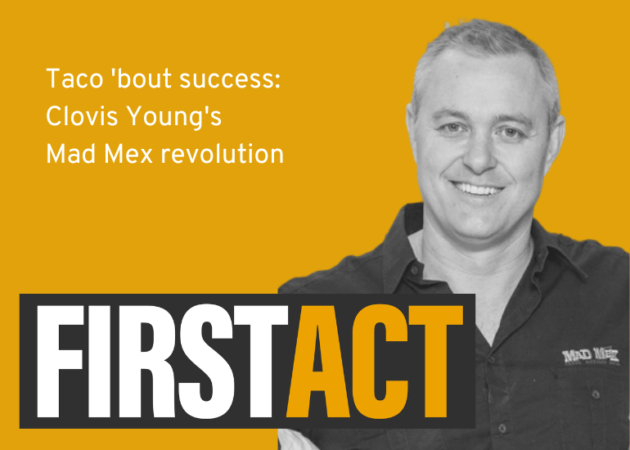
Clovis Young founded one of Australia’s tastiest fast-food success stories, Mad Mex Fresh Mexican Grill. With over 70 restaurants operating in Australia and New Zealand, Mad Mex has been a significant disruptor in the fast-food industry, offering healthier alternatives that set them apart from their industry competitors. Clovis joined the First Act podcast to share the Mad Mex story and top advice for other entrepreneurs considering franchising their businesses.
Harking back to childhood holidays spent in San Diego, the southern Californian local recalls how his passion for Mexican fast food was born when eating from a humble local business operating from a shack in a car park.
“By modern standards, it was a very simple setup,” Clovis recollects. “We’d buy these carne asada burritos – a grilled steak burrito with guacamole. And the food blew my mind. Nothing else in that formative, early childhood period stood out as much as the perfection of this burrito that nailed every element.”
Kicking off his business career with an MBA and a successful stint on Wall Street, Clovis’ love of Mexican cuisine endured and inevitably led to dreams of opening his own restaurant – an industry he had never worked in before. A visit to Sydney with his then-wife sealed the deal when he discovered a tasty gap in the Aussie fast-food market.
“I kept coming back to this idea about that first perfect burrito,” he says. “How many years do you have to listen to the voice in your head before you say, I need to put this to rest somehow?
“In Sydney, I made a point of visiting every Mexican restaurant I could find, from the eastern suburbs to north Sydney to the Manly area. And what was very clear was what we thought of as Mexican food – the burritos and tacos, the quick casual dining, those fast-casual concepts – didn’t exist. There were restaurants where you could take your family and get a big plate of food, but nothing matched our vision of what Mexican should be. So, we moved to Australia with the idea of opening a Mexican fast-food restaurant. And prayed that we’d figure out how to make that work,” he laughs.
Work it eventually did, but the journey was not without its challenges. Bootstrapping the early stages of the business with their savings, Clovis and his then-wife Angela opened three Mad Mex venues in quick succession. However, expanding beyond this point would require more capital, and a tough decision was upon them: find investors or franchise the business.
“Franchising came from having to choose a path because we were close to tapped out,” Clovis admits. “The options were to bring in an investor who looks at a P&L statement that doesn’t look wildly successful or look at franchising. Franchising solved a couple of issues for us. One, it created capital to expand. Secondly, we also found it very difficult to find great managers for these restaurants. So, getting someone with experience, the capital, and they’re passionate about the product solved a human resources question for us. Allowing us to retain the ownership of the business and getting partners equally passionate to us was a good combination.”
Clovis says there were two main challenges to expanding Mad Mex into a successful franchise – learning to operate in new territories and his lack of experience.
“We made incredible mistakes, not having more experience,” Clovis concedes. “We were winning customers and were very happy with how the business was performing from a PR and a customer acquisition perspective. We knew how to make a great product and how to make customers happy – but we didn’t know how to run a food business.
“It wasn’t until I brought in my first experienced food operations guy to help run the business that we worked out the fine-tuning. This is a tough, competitive, narrow-margin field, and you need to set it up to get the right profitability while also delivering a great customer experience and product. You also have to ensure the machine is designed to make some money because there’s not a fat profit margin to make mistakes with.”
Backed by more robust business operations, Clovis then tackled new states and expanded into New Zealand, which came with its own set of hurdles.
“For businesses that are local brands, who have an iconic nature in their community, going from one country to another is a complete rebrand, a new startup,” he says. “Even taking Mad Mex from Sydney to Melbourne is like a new country – there are five million people that have never heard of you. So you have to create the same magic in that new state or foreign country to win that new market.
“We borrowed a concept from a brand that we think is brilliant, Grill’d Burgers. Their concept is: you don’t build or open a store; you plant a store like a tree. Then you need to water that tree, and it will grow. You then add customer love and great products and service, and you have to integrate yourself into that community. Restaurants are inherently local area businesses, right? So, you need to figure out who your immediate customers are and try to figure out how to win that set of hearts and minds first. Then you expand from there.
“Nowadays, we use big data to give us insights around whether we think a location might be successful. But in the early days, it was asking questions like, Do these people look like the kind of people who are going to be excited when we open? Is it busy enough? Is the visibility good enough?
“The big learning is not spreading yourself too thin,” Clovis advises. “It is a better strategy to grow organically, almost in a sequence – and that comes back to the community, to locals. For example, we sell 250 burritos a day, and people might come in once a month. So, you have to win over 20,000 customers to be successful. It has to have a mass market appeal, and you have to win a lot of hearts and minds, which is important.”
Clovis has a couple of excellent tips for fellow would-be entrepreneurs looking to expand their businesses:
“Entrepreneurship is about identifying a problem,” says Clovis. “Figuring out what the puzzle is, the best way to solve the puzzle, and trying it. Then realising you’re probably not going to get it a hundred per cent right and going back and do it slightly better. Then, finally, it’s about trying to get to a point where that piece is solved so you can focus on the next big puzzle.”
One of the most valuable pieces of advice Clovis ever received was from ex-wife Angela’s late stepfather, Jewel Supermarkets magnate Jim Fleming.
“He said, ‘the only advice I can give you is, put your nose down, bum up for five years. If you work your bloody guts out for five years, then – and only then – pick your head up and look around. Only then will you know if you’ve been successful. There’s nothing between that starting point and a significant amount of blood, sweat and tears before you’re gonna have any clue as to whether or not you’ve made it.’
“And that was really great advice because it wasn’t for at least five or six years before we got to the point where we made it over that first patch.”
Clovis shared plenty more insights into his successful franchise on the First Act podcast. Listen to the full ep now.
Join us every second Tuesday for a brand new episode of First Act, because every story has a beginning.


Suze English is a writer, content producer and social media manager with 15 years of experience bringing editorial and website content and social media to life for Australian businesses.


Comments