


The ‘future fit’ test: 5 questions every family business needs to answer


For a family business to survive conflict, generational change and economic challenges, there needs to be a delicate balance between legacy and future.
There’s a moment in Stanley Tucci’s Searching For Italy TV series that captures a quintessential family business dynamic.
The Hollywood star meets a fourth-generation cheesemaker in Puglia named Vito, who co-owns his grandfather’s cheese shop, Caseificio Dicecca, with his four siblings.
His grandfather’s specialty was mozzarella. Vito went travelling and came back home with a big idea that no one in the region had done before: to make a Puglian blue cheese.
His family said he was crazy. But Vito persisted. He sought their (at-times) brutal feedback and perfected the recipe.
Now, he’s created 66 types of blue cheese – and the world knows about it.
It’s this balance of old and new – tradition and modernity – that family businesses grapple with all the time.
Being too wedded to legacy can be an “impediment to progress and growth,” says Robyn Langsford, Global Lead, KPMG Private Enterprise Family Business. But at the same time, younger generations can’t be in a rush to change everything overnight.
While trust, purpose and community are central to any family business operation, the house can come crumbling down if everyone’s not on the same page. Langsford says there are five crucial questions all family businesses should ask themselves to be “future fit”:
“What we are typically seeing is that the younger generations that come in have values that are probably more strongly aligned to ESG principles (Environmental, Social and Governance) than perhaps previous generations,” Langsford says.
“So [it’s about] getting alignment as to how the younger generations have a voice and embed those values in the way that they run the business, but without excluding the older generation who perhaps might have done things differently in the past. They need to be open to change, but they also need to feel like they’re included in the next chapter of the business.”
The Sages: A family business success story is a helpful case study to read if you want to see how this works in practice. Produced by KPMG with Professor Christine Blondel from INSEAD business school, the fictional tale explores how a family tackles transition, wealth, people, growth, risk and governance as the business goes from local grocer to international supermarket chain.
With some family businesses, this is a no-brainer. But others need time and outside consulting to reach a consensus.
“For example, I just spoke with a fifth generation family business, and they probably took a good year and a bit to get their future strategy and future vision fleshed out,” Langsford shares.
“I think because the greater number of generations that you’ve got to take on the journey, the more complex a process it is.”
In the Sages story, there are both internal and external risks at play. For example, as founder Thomas pulls back from the business, there’s a power vacuum – like on the TV show Succession – where different stakeholders want to have a stronger impact on the direction of the business.
Externally, there are pressures around international expansion and digital transformation.
Langsford says that other risks like cyber security and global conflicts are playing an increasingly large role in forward planning.
“In the current environment, geopolitical risk cannot be downplayed, and that’s something perhaps historically that family businesses in Australia didn’t have to attach such a great weight to,” Langsford explains. “And just at home, there’s our own economic challenges as well.”
Amid all the planning for the worst scenario, you’ve also got to plan for the best.
“You’ve got to have a goal that you’re driving towards,” says Langsford. “Just because the current environment has lots of impediments and challenges, it doesn’t mean that you can’t dream big and aim for something that when the economy starts to pick up again, you’re well positioned.”
In the Sages example, various stakeholders want to expand the supermarket internationally. But there are disagreements over how they’re going to do it. That takes us to the final question family businesses need to ask…
You’ve identified your risks and aspirations. Now how do you agree on the best path forward?
Langsford refers to the “Three Circle Model” of governance in family enterprise as a way of prioritising competing voices when coming up with future plans.
The three circles cover Family, Business and Owners, as below:
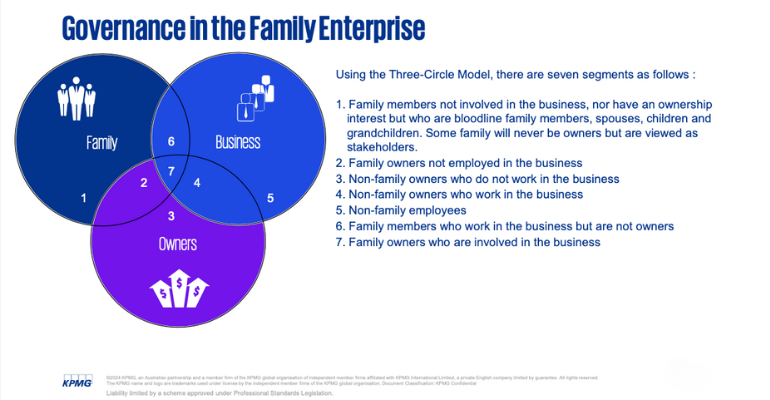
“Getting alignment between those three concurrent systems and doing the planning in parallel is paramount,” Langsford says.
In the Sages story, they navigate the differing needs of family members (including cousins), owners and other stakeholders in the business. They identify three areas they need to address:
While not all businesses will land at these particular conclusions, all family businesses can benefit from taking a moment to think about values, vision, risks, aspirations and future plans. And if they involve Puglian blue cheese, even better.
Find out more about KPMG’s family business services here. Read the full Sages case study here.
This article is brought to you by Kochie’s Business Builders in association with KPMG Australia.
Feature image: AdobeStock

Adam Bub is the Head of Commercial Media at SmartCo Media (formerly Pinstripe Media), managing digital and TV partner content for Business Builders, Startup Daily, SmartCompany, Flying Solo and Your Money & Your Life. Previously an editor at Nine Digital and Mamamia, Adam is a strategic storyteller who loves creating value for audiences and brands. Adam has led content-driven media campaigns for 100s of global and local brands, including IKEA, Amazon and Dell Technologies. Adam interviews entrepreneurs on the Business Builders podcast First Act.


Comments