


Aussie small businesses juggle uncertainty with a dash of optimism


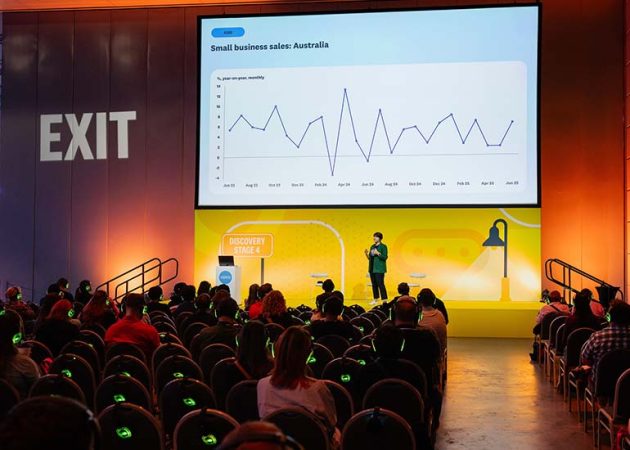
If there’s one word that sums up 2025 for Aussie small businesses, it’s uncertainty. At least, that’s the verdict from Xero economist Louise Southall, who told a packed room at Xerocon that even the experts are scratching their heads.
“If an institution like a central bank is saying, look, we’re not really sure exactly what is happening with the economy right now… what hope does the average small business have?” she asked.
Fair point. With US trade policy shifting, tariffs in, tariffs out; Australia Post pausing parcels to the States, then a pending court decision possibly undoing it all, Southall said small businesses everywhere are feeling the pinch.
“Forecasting [has become] very difficult … all of this chopping and changing is making forecasting very difficult.”
The data backs it up. Xero’s Small Business Insights showed Aussie sales growth slowing to just 1.6 per cent in April and May, the weakest quarterly growth since 2022. Over the ditch, things are even tougher, with Kiwi small business sales actually falling by 0.1 per cent in the June quarter.
Still, as Southall pointed out, “most small businesses are surviving largely thanks to your help,” giving a nod to the advisors and bookkeepers guiding businesses through the fog.
Joining Southall on stage was Susan Toft, CEO of The Laundry Lady, a business that’s grown to nearly 400 contractors across Australia and New Zealand. Toft said her word for 2025 is “momentum.”
Despite the slowdown, The Laundry Lady clocked 40 per cent revenue growth in the past year.
“We’re still having really good growth … New Zealand has definitely been a much more challenging market … but it hasn’t stopped us from recruiting. We still have 25 contractors in New Zealand.”
And she’s got bigger plans: “We’re getting ready to go into Canada and the UK as well.”
Her secret sauce? Diversification. “We really have a very broad range of customers … from residential to beauty salons, medical clinics, Airbnbs … it tends to be more about behaviour — people who hate laundry — rather than who they are.”
She’s also raised $1 million in investment to fuel expansion. But she insists sticking to her values has been just as important as chasing growth: “Remaining true to [our values] when we go into new markets … is really has been a very important part of our strategy.”
And yes, contractors are making between $300 and $3,000 a week. “It’s a lot of laundry,” Southall quipped.
For Jason Robinson, co-founder of Future Advisory, uncertainty is nothing new. “The rise in prices, insurance premiums, energy prices … wage increases … regulation changes … it’s a jungle out there for small business owners.”
But he reckons the best defence is in the numbers.
“Really focus on cash flow … get it into a weekly kind of system where if something hasn’t happened that was expected, you need to be able to make faster decisions.”
He also urged businesses not to be shy about lifting prices.
“When was the last time you raised the prices? … as a profession we are quite guilty of not putting up our own prices. We bring considerable value … and we really do need to look at how we can raise our own.”
And, of course, according to Robinson, data is king.
“We are so privileged in this day and age to have almost real-time access to data … having access to that data to be able to make really smart decisions with real-life data … that’s really important.”
Both Toft and Robinson say tech is playing a big role in keeping business humming.
Toft’s team is rolling out a new platform and app after outgrowing their off-the-shelf systems. She’s leaning on AI to streamline everything from ad campaigns to recruitment.
“Every new position it’s [a question of] what can we replace with AI before we hire that new position?”
Robinson, meanwhile, reckons it’s less about new tools and more about better using what you’ve already got. His firm even used AI to automate birthday messages for thousands of clients.
“At one stage the admin team were like, oh, this is so annoying … next thing they’re like, oh, this is the best, we should do more AI automation.”
When asked about the year ahead, Toft was upbeat: “It’s gonna be smashing. They’re just gonna go for gold.”
Robinson was a touch more cautious but still hopeful: “Optimistic … small business owners that are controlling their numbers and have great strategies … They’re the ones that we want to work with … being optimistic and pushing forward into 2026 with a good bill of health.”
Southall summed it up neatly: small businesses have weathered turbulence before, and they’ll do it again. The key, she said, is sticking to strategies that work — “staying on top of your numbers, understanding your business, planning, and working with your accountant and bookkeeper.”
In other words: keep calm, crunch the numbers, and maybe outsource the laundry.
Disclaimer: The author was a guest of Xero at Xerocon
Want more? Get our newsletter delivered straight to your inbox! Follow Business Builders on Facebook , X , Instagram , and LinkedIn.

Editor
Cec has been telling stories and chasing headlines for more than 25 years. These days, she’s editor of Private Media’s Business Builders and Flying Solo, and the voice behind the Flying Solo and First Act podcasts. She kicked off her editing career as the founding editor of Sydney street press The Brag and has since worn the editor’s hat across a stack of titles – from SX and CULT to Better Pictures, Total Rock, MTV, fasterlouder, mynikonlife and Fantastic Living. Cec’s reporting runs the gamut. She’s covered small business, politics, health and LGBTQIA+ issues with equal passion. And when she’s not in print or online, you might have caught her behind the mic at FBi Radio or in front of the camera on OutTV.


Comments