


Workplace Gender Equality Scorecard reveals women remain underrepresented and underpaid


The findings from the annual Workplace Gender Equality Scorecard have been released and women are still trailing far behind men when it comes to pay and promotions.
The Scorecard includes the latest figures on the gender pay gap, industry comparisons, women’s workforce participation, women’s representation in leadership and emerging trends in employer action.
While the gender pay gap is continuing to fall, the 2020-21 report found women still earn $25.8k less than men on average, with the pay gap sitting at 22.8 per cent. While four in ten businesses report narrowing their pay gap, an almost equal number (37 per cent), admit their pay gap has widened. Seven in 10, Australian employers pay men significantly more than women on average. Most organisations (73 per cent) have a pay gap in favour of men, on average; 20 per cent have close to no pay gaps; and only 7 per cent have a pay gap in favour of women.
Men are twice as likely as women to be in the top-earning bracket taking home $120k and above. By contrast, almost one-in-three women are in the lowest-paid bracket of full-time employees in Australia, while around one in three men are in the top earnings bracket.
The report found every manager category and non-manager occupation has a gender pay gap favouring men. In fact, all industries have a pay gap in favour of men. Even in sectors that are dominated by female workers, the pay gap persists. In Health Care and Social Assistance and Education and Training, women account for over 60 per cent of the workforce, but these industries both have a pay gap in favour of men (14.4 per cent and 10.5 per cent respectively).
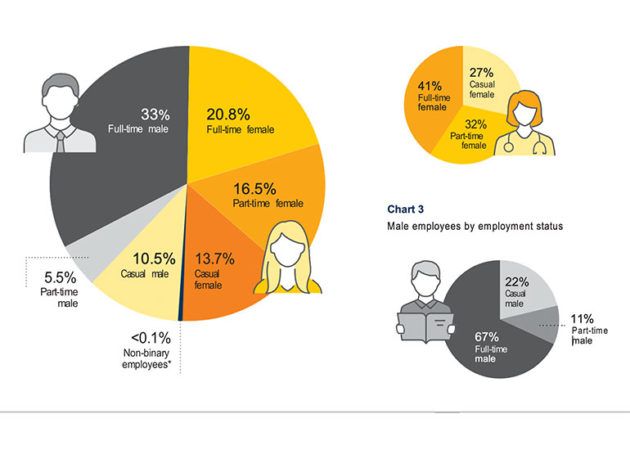
The 2020-21 data shows that industries and occupations, as well as working patterns, continue to be highly gender-segregated. Women bore some of the greatest impacts during the pandemic, with high concentrations of women in industries such as retail. Front-line employees – teachers, nurses, and shop assistants – are predominantly women accounting for approximately 60 per cent of these workforces. Women also dominate precarious employment, comprising 57 per cent of the casual workforce. In Australia, part-time employment is female-dominated and highly segregated between occupations and industries. In male-dominated industries, 84 per cent of employees work full-time compared to 35 per cent in female-dominated industries. In gender-mixed industries, 47 per cent of employees work full-time.
The scorecard reveals gender parity continues to be an issue in leadership. While the number of women in leadership roles has increased since the WGEA data collection began, the progress towards gender balance remains slow. The representation of women in leadership declines with seniority.
In 2020-21 less than one in five CEOs or business leaders are women (19.4 per cent). Overall, two in five managers are women. Only one in four organisations (24 per cent) have a gender-balanced leadership team (40-60 per cent females in senior leadership roles). Boards remain male-dominated with only one in five having gender balance. Despite this, only 12 per cent of boards have targets in place to increase their female representation.
Want more? Get our newsletter delivered straight to your inbox! Follow Kochie’s Business Builders on Facebook, Twitter, Instagram, and LinkedIn.

Editor
Cec has been telling stories and chasing headlines for more than 25 years. These days, she’s editor of Private Media’s Business Builders and Flying Solo, and the voice behind the Flying Solo and First Act podcasts. She kicked off her editing career as the founding editor of Sydney street press The Brag and has since worn the editor’s hat across a stack of titles – from SX and CULT to Better Pictures, Total Rock, MTV, fasterlouder, mynikonlife and Fantastic Living. Cec’s reporting runs the gamut. She’s covered small business, politics, health and LGBTQIA+ issues with equal passion. And when she’s not in print or online, you might have caught her behind the mic at FBi Radio or in front of the camera on OutTV.


Comments